
Hair Transplant Techniques - FUE, FUE & MMFT
Navigating Your Hair Transplant Journey: FUE, FUT, and MMFT
Choosing the right hair transplant technique is a significant decision, and it is common for patients to feel overwhelmed by the conflicting information available. You may have been told that FUE is entirely "scarless," or you might be unsure if your specific hair type—such as curly or white hair—is suitable for certain procedures. Understanding the nuances of each method is essential to achieving natural, long-lasting results while protecting your donor area.
Two of the most common traditional methods are Follicular Unit Extraction (FUE) and Follicular Unit Transplantation (FUT). While FUE is often marketed as the modern, scar-free choice, it is important to know that every surgical extraction leaves some form of scarring. Furthermore, FUE can have limitations when it comes to curly hair or very large sessions, whereas FUT remains a gold standard for graft survival in specific hair types.
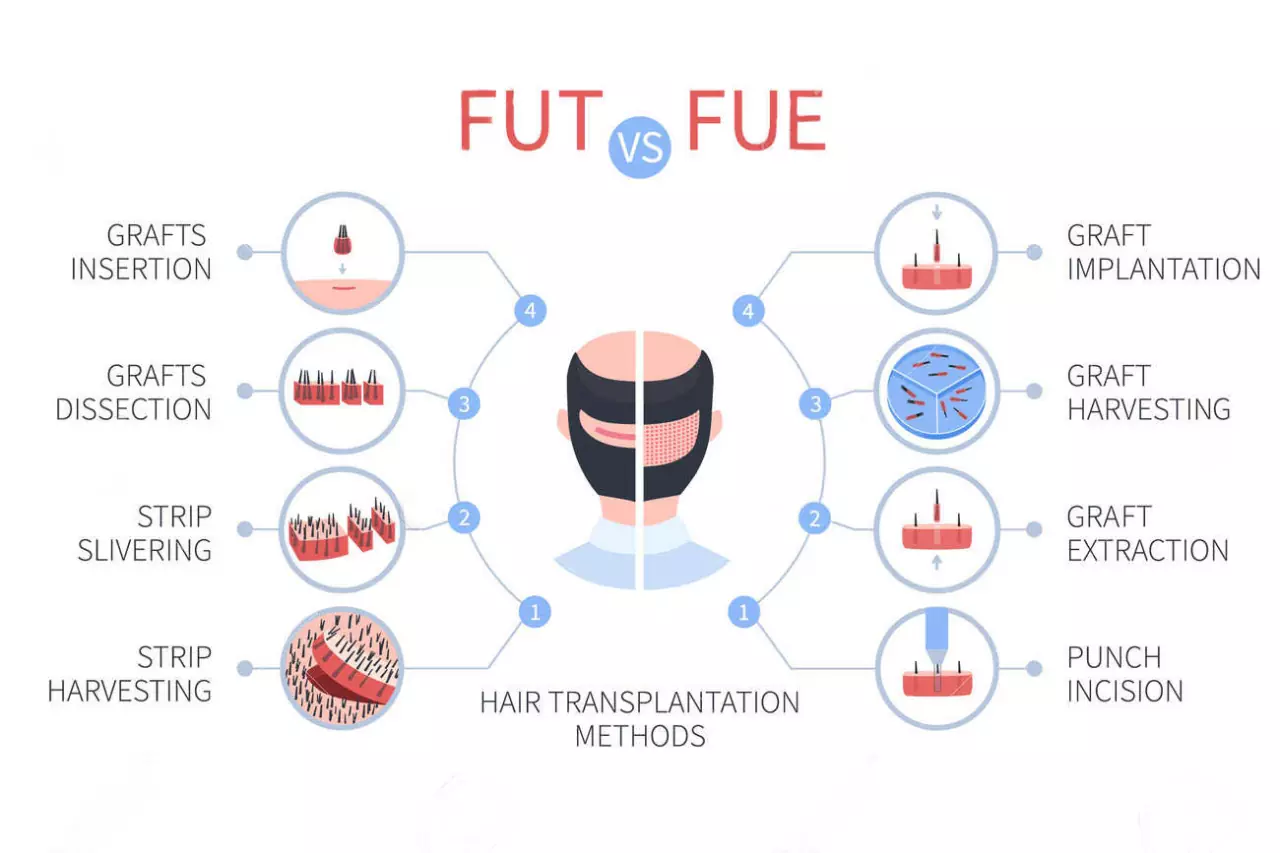
Comparing FUE and FUT: Key Differentiators
To help you decide which technique aligns best with your goals, the following table breaks down the critical differences between FUE and FUT, from graft harvesting to long-term recovery.
| Differentiating Factor | FUE (Follicular Unit Extraction) | FUT (Follicular Unit Transplantation) |
|---|---|---|
| Technique | Grafts harvested directly from donor area with punches. | Strip harvested; grafts separated under a microscope. |
| Hair Trimming | Mandatory (except in specialized Zonal FUE). | Not needed (Long hair technique requires no cutting). |
| White Hair Transplant | Very good results. | Higher wastage (approx. 30-40%). |
| Curly Hair Transplant | High wastage (approx. 20-25%). | Very good results. |
| Donor Site Thinning | Possible in large harvestations. | Not possible. |
| Permanent Zone | Often crosses boundaries to get more grafts. | Always stays within the permanent zone. |
| Longevity of Results | Potential losses over a 10-year period. | Results are nearly permanent. |
| Grafts per Session | Should generally not exceed 2,500. | Can go up to 3,500. |
| Additional Scars | Multiple sessions add more punch scars. | Second sessions remove the previous scar. |
| Donor Site Damage | Possible due to high-speed drills. | None. |
| Scar Distribution | 5 to 6 times wider total area. | One linear scar. |
| Wound Treatment | Left open to heal. | Closed with sutures. |
| Total Scar Size | Hundreds of small punch scars; 10x larger total area. | One thin linear scar. |
The Advantages of MMFT: A Superior Combination Approach
For patients requiring extensive coverage, neither FUE nor FUT alone may be the ideal solution. This is where MMFT (Modified Multi-Follicular Technique), or Combination Hair Transplant, becomes the preferred choice. MMFT offers a flexible approach by combining different techniques—such as FUT + FUE or FUE + Beard Hair—to maximize the number of grafts while preserving the donor site.
Why Choose MMFT?
- Maximum Flexibility: We can combine FUT, FUE, and even beard hair transplants in varying ratios to suit your specific needs.
- Donor Preservation: By using a combination of methods, the donor site is largely preserved, making future sessions possible if needed.
- Faster Recovery: Despite the complexity of the procedure, MMFT is designed for rapid healing and minimal downtime.
- Large Area Coverage: MMFT is particularly effective for patients with Grade 6 baldness or higher, where more than 3,000 grafts are required.
- Efficiency: Extraction and implantation can occur simultaneously, allowing for large segments of baldness to be covered in a single session.
If you are looking for a comprehensive solution that provides the highest density and the most natural-looking results in a single session, MMFT represents the cutting edge of hair restoration technology. By tailoring the technique to your hair type and the extent of your hair loss, we ensure a result that is both beautiful and permanent.