

The Evolution of Regenerative Aesthetics in India
In recent years, the Indian aesthetic landscape has shifted from merely 'filling' lines to 'regenerating' the skin from within. While traditional dermal fillers and Botox remain popular, a new era of regenerative aesthetics has emerged, focusing on biological repair rather than temporary camouflage. Leading this revolution is PDRN (Polydeoxyribonucleotide), a sophisticated treatment often referred to as the polynucleotide skin booster. For patients in India seeking a natural, long-lasting glow and structural skin repair, PDRN offers a scientifically backed solution that works at a cellular level.
What is PDRN? The Molecule Explained
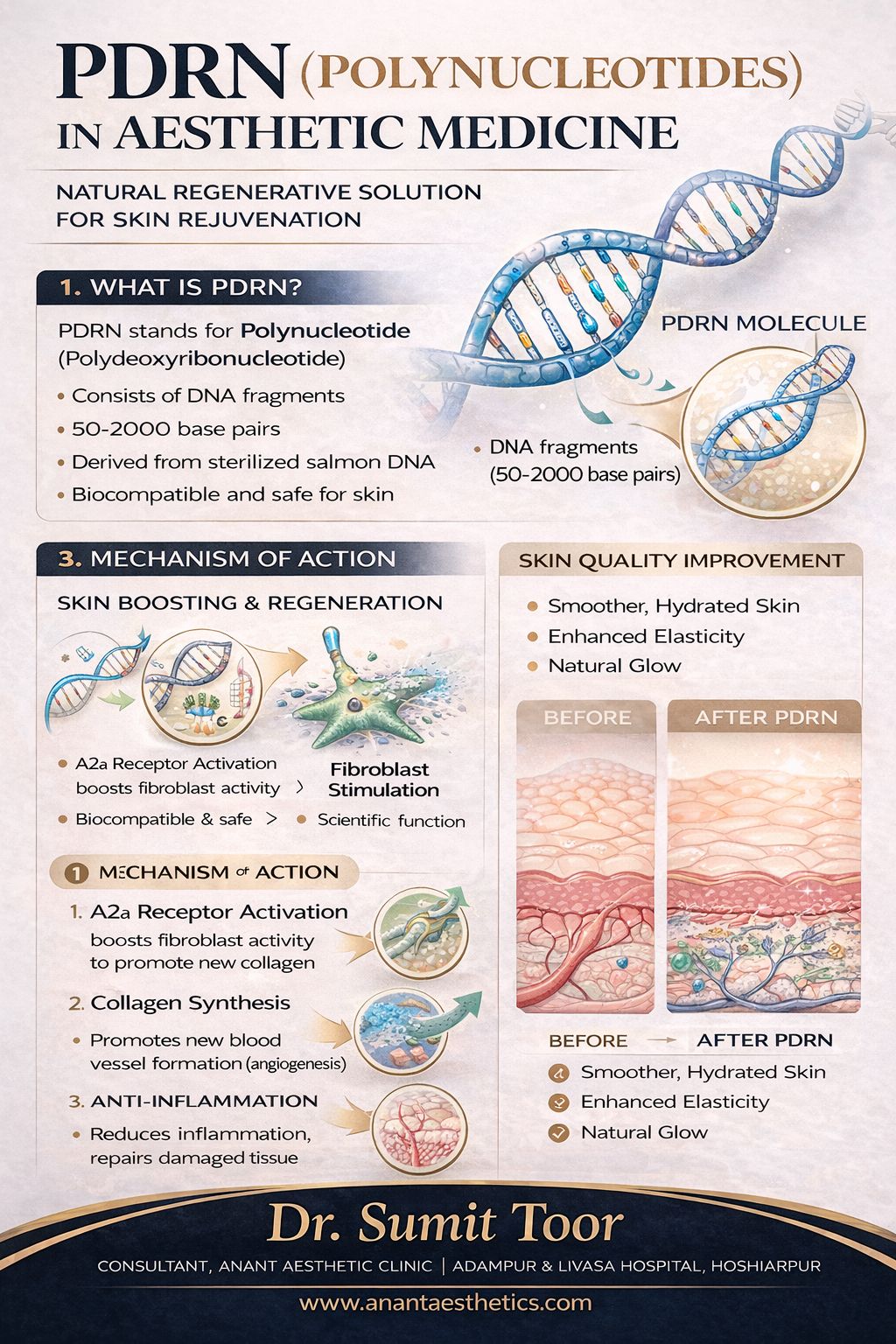
PDRN stands for Polydeoxyribonucleotide. At its core, it is a mixture of deoxyribonucleotides—essentially fragments of DNA—ranging between 50 and 2000 base pairs. These fragments are most commonly derived from the germ cells of salmon (Oncorhynchus mykiss). You might wonder, why salmon? Research has shown that salmon DNA is incredibly similar to human DNA, making it highly biocompatible and safe for use in medical and aesthetic treatments.
When injected into the skin, these polynucleotides act as building blocks for tissue repair. Unlike traditional treatments that might just add volume, PDRN provides the raw materials and the biological signals necessary for the skin to heal itself. It is highly purified to remove any proteins or peptides that could cause an allergic reaction, ensuring a high safety profile for all skin types, including the sensitive skin often seen in the Indian climate.
Physiology & Mechanism of Action: How It Works
The magic of PDRN injection benefits lies in its unique mechanism of action. It doesn't just sit in the skin; it actively communicates with your cells. The primary pathway is through the activation of A2A adenosine receptors. When these receptors are triggered, they kickstart a cascade of beneficial biological processes:
- Fibroblast Stimulation: Fibroblasts are the 'factory' cells of your skin. PDRN wakes them up, prompting them to produce more collagen and elastin, which are essential for firmness and elasticity.
- Angiogenesis: This is the formation of new blood vessels. By improving microcirculation, PDRN ensures that your skin cells receive more oxygen and nutrients, leading to a healthier, more vibrant complexion.
- Anti-inflammatory Effects: PDRN helps reduce inflammation and scavenge free radicals, making it an excellent choice for patients dealing with environmental damage or post-procedure sensitivity.
- DNA Synthesis: It provides a 'salvage pathway' for DNA synthesis, allowing cells to repair damage from UV radiation and aging more efficiently.
Indications: Who Can Benefit from PDRN?
PDRN is a versatile tool in the aesthetician's toolkit. In India, where issues like pigmentation, acne scarring, and pollution-induced aging are common, PDRN is particularly effective for:
- Under Eye PDRN Treatment: One of the most popular uses is for the delicate periorbital area. It helps thicken the thin skin under the eyes, reducing the appearance of dark circles and fine lines (crow's feet) without the 'puffiness' sometimes associated with fillers.
- Skin Rejuvenation: Improving the overall texture and tone of the face, neck, and hands.
- Acne Scars: By promoting tissue regeneration, PDRN helps fill in atrophic acne scars and smooths out the skin surface.
- Photoaging: Repairing skin that has been damaged by chronic sun exposure, a frequent concern in the Indian subcontinent.
- Post-Laser Healing: It significantly shortens the downtime after aggressive laser treatments or chemical peels by accelerating the healing process.
- Hair Restoration: When injected into the scalp, PDRN can help revitalize dormant hair follicles and improve hair density as an adjunct to other treatments.
The Treatment Protocol
A typical PDRN treatment India involves a series of micro-injections or mesotherapy techniques. The procedure is relatively quick, usually taking about 30 to 45 minutes. A topical numbing cream is applied beforehand to ensure patient comfort.
For optimal results, a protocol of 3 to 4 sessions is usually recommended, spaced about 2 to 4 weeks apart. Unlike fillers, which show immediate results, PDRN works gradually. You will notice a subtle improvement after the first session, but the full regenerative effect peaks after the third session as collagen remodeling takes place. Maintenance sessions every 6 months are recommended to sustain the youthful glow.
PDRN vs. Other Treatments
It is important to distinguish PDRN from other popular injectables:
- PDRN vs. PRP (Platelet-Rich Plasma): While both are regenerative, PDRN is a standardized, 'off-the-shelf' product with a consistent concentration of active ingredients. PRP depends on the quality of the patient's own blood, which can vary based on age and health.
- PDRN vs. Hyaluronic Acid (HA) Fillers: HA fillers provide volume and hydration by holding water. PDRN does not provide volume; instead, it repairs the skin structure. They are often used together for a synergistic effect.
- PDRN vs. Exosomes: Exosomes are signaling vesicles that tell cells what to do. PDRN provides both the signal (via receptors) and the physical building blocks (nucleotides) for repair.
Results and the "Glass Skin" Effect
The hallmark of PDRN treatment is the "glass skin" effect—a complexion so smooth, hydrated, and clear that it appears like glass. Patients report improved skin elasticity, a reduction in pore size, and a natural radiance that looks healthy rather than "done." Because it stimulates your own biology, the results look entirely natural and improve the skin's resilience against future aging.
Safety, Side Effects, and Cost in India
PDRN is remarkably safe. Common side effects are minimal and temporary, including mild redness, slight swelling, or tiny bumps at the injection site that typically resolve within 24 to 48 hours. Allergic reactions are extremely rare due to the high purification process of the salmon DNA.
The cost of PDRN treatment in India varies depending on the clinic's location and the specific brand of polynucleotide used. On average, a single session can range from ₹15,000 to ₹30,000. Many clinics offer package deals for the recommended 3-session course, which can be more cost-effective for patients.
Conclusion
PDRN represents a significant leap forward in aesthetic medicine, offering a bridge between traditional skincare and invasive procedures. By harnessing the power of polynucleotides, patients can achieve genuine skin health and a youthful appearance through natural regeneration. Whether you are looking for an under eye PDRN treatment or a full-face rejuvenation, this "skin booster" is a safe and effective choice for the modern Indian patient.
Dr. Sumit Toor, Consultant at Anant Aesthetic Clinic, Adampur.
Website: www.anantaesthetics.com
Anant Aesthetic Clinic, Adampur