

Introduction
For many individuals, the nose is a central feature that defines facial harmony. While surgical intervention was once the only way to alter its shape, the rise of liquid rhinoplasty has revolutionized the field of aesthetics. Often referred to as a "non-surgical nose job," this procedure offers a way to reshape and contour the nose without the need for incisions, general anesthesia, or lengthy recovery periods.
What is Liquid Rhinoplasty?
Liquid rhinoplasty is a minimally invasive procedure that utilizes injectable hyaluronic acid (HA) fillers to temporarily alter the shape of the nose. Unlike surgery, which modifies the underlying bone and cartilage, fillers work by adding volume to specific areas to camouflage imperfections and improve the nasal profile.
The procedure is remarkably quick, often taking only 15 to 30 minutes. Because it involves simple injections, the results are visible almost immediately, making it a popular "lunchtime" treatment for those seeking subtle yet impactful enhancements.
What is Surgical Rhinoplasty?
Traditional surgical rhinoplasty is a permanent procedure performed by a plastic surgeon. It involves either an "open" or "closed" technique to access the nasal structure. During surgery, the doctor physically modifies the bone and cartilage to change the size, width, or angle of the nose.
Because it is a major surgical undertaking, it requires general anesthesia and a significant recovery period—usually involving swelling and bruising that can last for several weeks, with final results taking up to a year to fully settle.
Key Differences: Liquid vs. Surgical Rhinoplasty
Choosing between these two options depends on your aesthetic goals, budget, and willingness to undergo surgery. Below is a comparison to help you understand the primary differences:
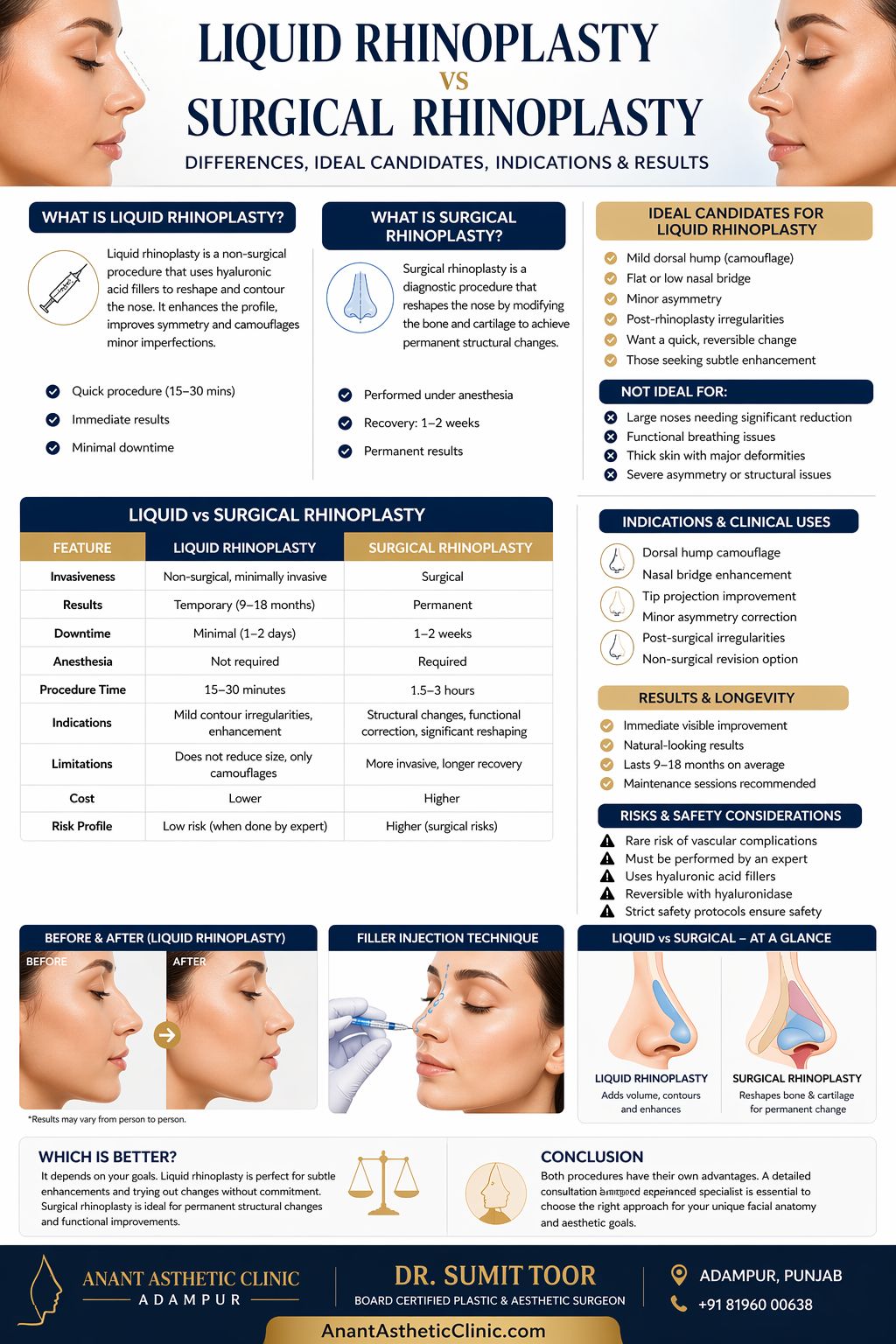
| Feature | Liquid Rhinoplasty | Surgical Rhinoplasty |
|---|---|---|
| Invasiveness | Non-invasive (Injections) | Invasive (Surgery) |
| Results | Temporary (9–18 months) | Permanent |
| Downtime | Minimal (0–2 days) | Significant (1–2 weeks) |
| Cost | Lower initial cost | Higher upfront investment |
| Anesthesia | Topical numbing cream | General anesthesia |
Ready to transform your profile? Connect with our experts today.
Connect with the doctor Follow us on Instagram Locate usIdeal Candidates for Liquid Rhinoplasty
Liquid rhinoplasty is an excellent option for patients looking for "addition" rather than "subtraction." You may be an ideal candidate if you have:
- A mild dorsal hump: Filler can be placed above and below the hump to create the illusion of a straight bridge.
- A flat nasal bridge: Adding volume can create a more defined profile.
- Minor asymmetry: Fillers can balance out small deviations.
- Post-rhinoplasty irregularities: It is often used to touch up minor defects left after a surgical procedure.
- A desire for reversible changes: Since HA fillers can be dissolved, it is a great "trial run" before committing to surgery.
Who should avoid liquid rhinoplasty? It is not suitable for patients who need to reduce the size of a large nose, those with functional breathing issues (like a severely deviated septum), or those with very thick skin and major structural deformities.
Indications & Clinical Uses
Clinically, liquid rhinoplasty is used to address several aesthetic concerns:
- Nose contour enhancement: Refining the overall shape for better facial balance.
- Dorsal hump camouflage: Smoothing the bridge of the nose.
- Tip projection improvement: Lifting a drooping nasal tip.
- Non-surgical revision: Correcting minor depressions or asymmetries from previous surgeries.
Results & Longevity
One of the most satisfying aspects of liquid rhinoplasty is the immediate visible improvement. While there may be slight swelling or redness at the injection sites, the new shape of the nose is apparent right away. The results typically last between 9 to 18 months, depending on the type of filler used and the individual's metabolism. Periodic maintenance sessions are required to sustain the look.
Risks & Safety Considerations
While non-surgical, liquid rhinoplasty is a high-skill procedure. The nose has a complex network of blood vessels, and vascular complications (such as filler entering a blood vessel) are a serious risk if performed by an untrained injector. It is vital to choose an expert medical professional who understands nasal anatomy and follows strict safety protocols.
A major safety benefit of using hyaluronic acid fillers is reversibility. If a patient is unhappy with the result or if a complication occurs, an enzyme called hyaluronidase can be injected to dissolve the filler instantly.
Liquid Rhinoplasty vs. Surgical Rhinoplasty: Which is Better?
There is no single "better" option; the choice depends entirely on your goals. If you want a permanent change, need to reduce the size of your nose, or have breathing difficulties, surgical rhinoplasty is the gold standard. However, if you want a quick, low-downtime enhancement to smooth out bumps or lift the tip, liquid rhinoplasty is an exceptional, less invasive alternative.
Conclusion
Both liquid and surgical rhinoplasty offer transformative results, but they serve different needs. The most important step in your journey is a thorough consultation with a qualified professional who can assess your anatomy and recommend the best path forward for your unique face.
About Anant Aesthetic Clinic
Anant Aesthetic Clinic, led by the expert duo of Dr. Sumit Toor and Dr. Pratibha Toor, is dedicated to providing world-class aesthetic and cosmetic treatments. Located in Adampur, the clinic combines medical precision with an artistic approach to help patients achieve their beauty goals safely and effectively. We pride ourselves on delivering natural-looking outcomes tailored to each individual's needs.
Anant Aesthetics | www.anantaesthetics.com
Anant Aesthetic Clinic, Adampur