

Walking into a skincare clinic can often feel like standing in front of a massive menu where every option sounds delicious, but you aren't quite sure which one will satisfy your hunger for perfect skin. Two of the most popular choices today are the Hydrafacial and the Chemical Peel. While both aim to rejuvenate your complexion, they work in very different ways. Choosing between them depends on your skin type, your concerns, and how much downtime you can afford.
What is a Hydrafacial?
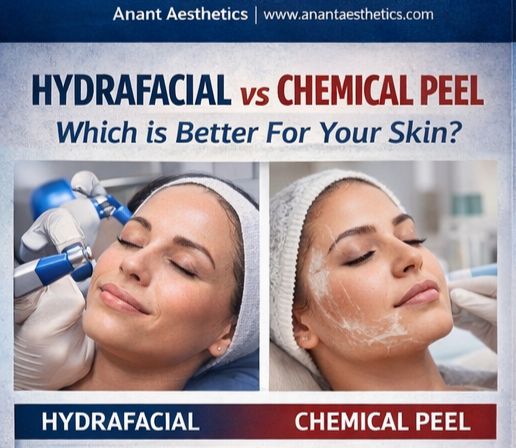
A Hydrafacial is a medical-grade resurfacing treatment that clears out your pores and hydrates your skin. It uses a patented three-part regimen—cleansing, exfoliating, and then infusing the skin with intensive serums. Often referred to as "hydradermabrasion," it uses a specialized device with a vacuum-like tip to gently suction out impurities while simultaneously delivering potent actives like hyaluronic acid, peptides, and antioxidants.
The result is an instant glow. Because it is non-invasive and incredibly gentle, it is often the go-to treatment before a big event. There is no irritation or peeling, just refreshed, plump, and radiant skin.
What is a Chemical Peel?
A chemical peel is a more traditional, yet highly effective, exfoliating treatment. It involves applying a chemical solution (usually an acid like Glycolic, Salicylic, or TCA) to the skin to speed up the cell turnover process. This causes the top layers of dead skin to eventually peel off, revealing smoother, more evenly pigmented skin underneath.
Chemical peels are categorized by their depth:
- Superficial Peels: Use mild acids to gently exfoliate the outer layer.
- Medium Peels: Reach the middle layer of skin to treat deeper wrinkles and acne scars.
- Deep Peels: Use stronger chemicals for more dramatic results, often requiring a longer recovery period.
Key Differences at a Glance
Understanding the mechanics of each treatment helps in making the right choice for your lifestyle:
- Procedure: Hydrafacial uses a machine-based suction and infusion method; a Chemical Peel relies on a chemical reaction to dissolve dead skin cells.
- Downtime: Hydrafacial has zero downtime. Chemical peels can involve 3 to 10 days of redness and visible peeling, depending on the strength.
- Results Timeline: Hydrafacial results are immediate. Chemical peel results appear after the peeling process is complete, usually after a week.
- Suitability: Hydrafacial is safe for almost all skin types, including sensitive skin. Chemical peels must be carefully selected based on the patient's skin tone and sensitivity.
Who Should Choose What?
Your specific skin concerns are the best guide for choosing your treatment:
- Acne: Hydrafacials are great for congested pores and blackheads. However, for active acne or deep acne scarring, a series of chemical peels is often more effective at resurfacing the skin.
- Pigmentation: While Hydrafacial can brighten the skin, chemical peels are the gold standard for treating stubborn melasma, sun spots, and hyperpigmentation.
- Dull Skin: If you need a quick pick-me-up for a tired complexion, the Hydrafacial is unbeatable.
- Sensitive Skin: Hydrafacial is generally safer for very sensitive skin, as the intensity can be easily adjusted.
Side Effects & Safety
Hydrafacials are virtually risk-free, with some patients experiencing very slight redness that fades within an hour. Chemical peels carry a bit more risk, such as temporary crusting, redness, or sensitivity to the sun. It is crucial to follow post-care instructions, especially sun protection, after a peel to avoid complications like post-inflammatory hyperpigmentation.
Cost Comparison
Generally, a single Hydrafacial session may cost more than a single superficial chemical peel because of the technology and serums involved. However, because chemical peels often require a series of treatments and specific post-care products, the long-term investment for both treatments is often comparable.
Can They Be Combined?
Absolutely! In fact, many dermatologists recommend a staggered treatment plan. You might start with a chemical peel to address deep pigmentation and follow up two weeks later with a Hydrafacial to deeply hydrate and soothe the newly revealed skin. A personalized consultation is the best way to determine a combined approach.
Decision Guide Summary
| Feature | Hydrafacial | Chemical Peel |
|---|---|---|
| Primary Goal | Hydration & Glow | Resurfacing & Correction |
| Pain Level | None (Relaxing) | Mild Tingling/Stinging |
| Downtime | None | 3-10 Days |
| Best For | Maintenance & Events | Scars & Pigmentation |
About Anant Aesthetic Clinic: Run by the expert duo Dr. Sumit Toor and Dr. Pratibha Toor, Anant Aesthetic Clinic is dedicated to providing advanced skincare solutions tailored to your unique needs. Whether you are looking for the instant refreshment of a Hydrafacial or the transformative power of a chemical peel, our team ensures a safe and professional experience.
CTA: Not sure which treatment suits you? Visit Anant Aesthetics for a personalized skin consultation at www.anantaesthetics.com.
Anant Aesthetic Clinic, Adampur