

When exploring options for thinning hair, you may have encountered the term hair filler treatment. As non-surgical hair restoration options continue to evolve, patients frequently ask whether these injectable formulations can help restore density and support healthier hair growth. At Anant Aesthetic Clinic in Adampur, Jalandhar, our approach is grounded in medical accuracy and realistic expectations.
It is important to understand from the outset that "hair filler" is a broad commercial category rather than a single standardized medical treatment. Because products vary widely in composition and regulatory background, professional guidance is essential before beginning any new regimen.
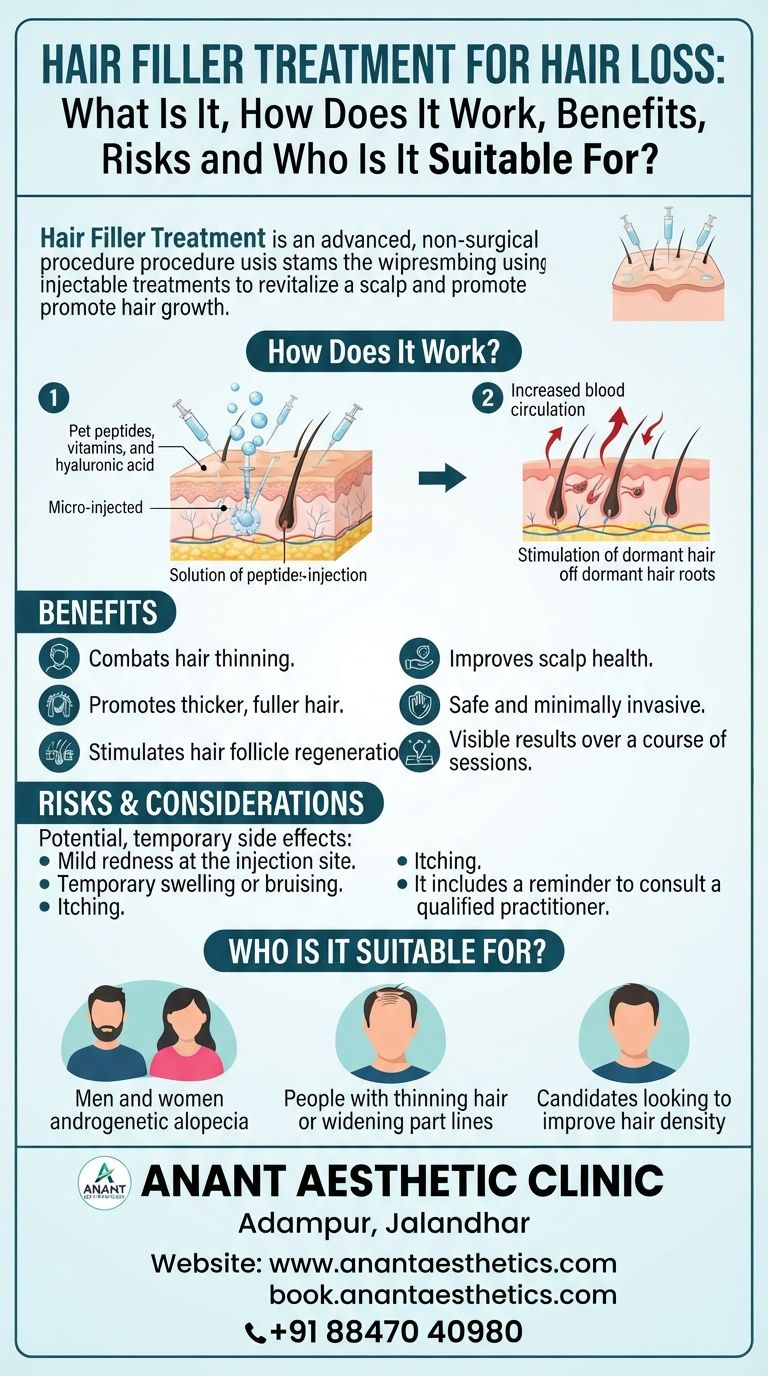
What Is Hair Filler Treatment?
The term hair filler refers to a range of specialized injectable products administered directly into the scalp. Unlike facial dermal fillers designed to restore lost volume or contour bone structure, products marketed as hair or scalp fillers are formulated to target the scalp environment and hair follicles.
Because "hair filler" does not describe a single standardized medical product, formulations can differ significantly. Depending on the brand and specific product used, these injectables may contain or combine:
- Hyaluronic acid-based formulations: Engineered to preserve hydration and optimize the extracellular scalp microenvironment.
- Polynucleotides (PDRN): Biologically active DNA fractions researched for their profound cellular repair and tissue-regenerative properties.
- Essential micronutrients: Concentrated vitamins, bio-peptides, amino acids, and minerals intended to nourish the dermal papilla.
- Proprietary biomimetic peptide complexes: Formulated to target follicular communication pathways.
Not all of these formulations are equivalent in their evidence base, mechanism, or safety profile. A consultation with a qualified hair loss doctor near Jalandhar helps clarify which specific products—if any—are appropriate for your unique clinical presentation.
How Does Hair Filler Work?
While mechanisms vary depending on the specific product formulation, injectable scalp treatments generally aim to improve the physiological environment of the hair follicles. Scalp micro-injections deliver active ingredients directly into the dermal layer where hair follicles reside.
Hyaluronic acid complexes may provide immediate hydration and structural support to the extracellular matrix around the hair follicle. Meanwhile, supplemental vitamins, amino acids, and polynucleotides aim to support cellular metabolism, improve microcirculation, and encourage healthier hair shaft characteristics over a series of scheduled sessions.
What Does the Scientific Evidence Say About Hair Fillers?
As a responsible aesthetic and hair-loss clinic, Anant Aesthetic Clinic emphasizes evidence-based care. It is vital to separate established, guideline-backed therapies from emerging interventions.
A notable clinical study published in recent literature evaluated a mechanically stabilized hyaluronic-acid complex supplemented with vitamins, ions, and amino acids in volunteers with moderate androgenetic alopecia. The study reported improvements in hair density, thickness, and appearance after a structured course of treatment sessions. However, due to the limited sample size and specific study design, this data should be considered preliminary clinical evidence rather than definitive proof that HA hair filler is a universal standard treatment.
Similarly, emerging evidence for PDRN (polydeoxyribonucleotide) injections shows promise in early laboratory and small-scale clinical studies. However, larger, well-designed randomized controlled trials are still needed before these treatments can be regarded as equal to established medical management.
Hair Filler and Androgenetic Alopecia
To understand where hair filler fits into a comprehensive plan, it helps to look at the primary cause of pattern thinning: androgenetic alopecia (male and female pattern hair loss).
In genetically susceptible individuals, circulating androgens—specifically dihydrotestosterone (DHT)—interact with receptors on hair follicles. This triggers a process known as miniaturization, where hair follicles progressively shrink over time. The anagen (growth) phase shortens, producing finer, shorter, and less pigmented hairs until visible thinning or baldness occurs.
While established medical management often relies on topical minoxidil and, in appropriate male patients, oral finasteride or other systemic blockers, emerging options like hair filler treatment may be considered as adjunctive therapies in selected patients rather than automatic replacements for proven gold-standard medications.
Who May Benefit From Hair Filler Treatment?
Candidate selection is paramount in aesthetic medicine. Potential candidates for hair filler for hair growth may include:
- Early to moderate thinning: Individuals experiencing initial hair thinning who want to proactively explore non-surgical options.
- Combination therapy responders: Patients diagnosed with androgenetic alopecia who are already utilizing standard medical therapies and seeking potential adjunctive benefits.
- Scalp revitalization candidates: Patients seeking targeted follicular nourishment and hydration recommended by their physician.
Results vary significantly from person to person, and evidence is still actively developing.
Who Should Avoid or Delay Hair Filler Treatment?
Hair filler is not suitable for everyone. A doctor may advise against or delay treatment in cases involving:
- Uncertain diagnoses: Unclear or undiagnosed hair loss causes requiring comprehensive laboratory workup.
- Active scalp disease: Active scalp infections, severe seborrheic dermatitis, or psoriasis in the targeted treatment zone.
- Inflammatory & scarring alopecias: Untreated scarring conditions (such as lichen planopilaris or frontal fibrosing alopecia), where injectables do not address underlying autoimmune destruction.
- Acute shedding: Significant, sudden telogen effluvium or systemic hair loss that demands internal medical diagnosis.
- Advanced baldness: Extensive hair loss where dormant follicles are fibrosed, making surgical hair restoration the appropriate clinical choice.
A proper diagnosis at our clinic ensures that you do not waste time and resources on treatments unsuited to your specific condition.
What Happens During a Hair Filler Treatment?
A professional hair filler procedure follows a structured clinical protocol designed to prioritize patient safety and comfort:
Thoroughly evaluating medical history, family genetics, and lifestyle factors affecting hair loss.
Utilizing high-magnification dermatoscopy to map follicle density and miniaturization ratio.
Selecting the precise peptide, HA, or PDRN formulation optimized for your scalp biology.
Structuring the frequency of sessions, dosage volume, and expected maintenance timeline.
Administering micro-aliquots under strict aseptic technique by an experienced physician.
Outlining scalp care protocols and scheduling objective trichoscopic follow-up evaluations.
Potential Benefits of Hair Filler
When performed as part of a personalized regimen, hair filler treatment benefits may include:
- Improved Hair Density: Improving the visual appearance of hair density and fullness in thinning areas.
- Enhanced Shaft & Scalp Quality: Enhancing overall hair shaft thickness and scalp hydration depending on the chosen formulation.
- Synergistic Medical Adjunct: Supporting overall hair health in selected patients as an adjunct to standard therapy.
- Minimal Downtime: Offering a comfortable non-surgical approach that allows immediate resumption of everyday activities.
Hair Filler Side Effects and Risks
While generally well-tolerated when performed by trained professionals, injectable treatments carry inherent risks. Common, temporary effects include:
- Mild pain or tenderness at the injection sites.
- Transient erythema (redness), localized swelling, or itching.
- Minor, temporary pin-point bruising along needle entry points.
More serious complications, though rare, must be understood. Injectable procedures can theoretically be associated with vascular compromise or localized tissue reactions. Published medical literature has documented rare cases of filler-induced alopecia following facial hyaluronic acid injections near the frontotemporal region due to vascular compromise. While ordinary scalp filler protocols differ from facial aesthetic injections, this underscores why procedures must be performed exclusively by trained medical professionals.
Clinical Warning: If you experience severe pain, skin discoloration, or unusual swelling following a scalp injection, seek immediate medical assessment.
Hair Filler vs PRP vs Minoxidil vs Hair Transplant
Choosing the right approach depends on your specific diagnosis, goals, and stage of hair loss. The following comparison outlines key hair restoration modalities:
| Treatment | Main Purpose | Evidence Level | Best Suited For | Type | Important Limitations |
|---|---|---|---|---|---|
| Hair Filler | Scalp hydration and targeted follicle support | Emerging / Preliminary | Early to moderate thinning, adjunctive care | Non-surgical | Not a standalone cure; ongoing sessions required |
| PRP (Platelet-Rich Plasma) | Autologous growth factors stimulate follicles | Moderate (clinical trials show variable efficacy) | Androgenetic alopecia, telogen effluvium adjunct | Non-surgical | Requires repeated maintenance sessions |
| Minoxidil | Prolonging anagen growth & boosting blood flow | High (Established standard) | Initial and ongoing treatment for pattern hair loss | Non-surgical | Requires lifelong daily use; shedding possible initially |
| Finasteride | Inhibiting DHT production at hormonal level | High (Established standard for men) | Slowing male pattern hair loss progression | Non-surgical | Prescription required; potential systemic side effects |
| Hair Transplantation | Relocating permanent follicles to balding areas | High (Surgical standard) | Advanced pattern baldness with stable donor supply | Surgical | Does not stop ongoing hair loss; higher initial cost |
Treatment Duration and Longevity
How Many Sessions Are Needed?
Treatment protocols for hair filler injections typically require an initial series of sessions—often spaced two to four weeks apart—to build cumulative benefits. Following the initial loading phase, maintenance sessions every few months may be recommended by your doctor to sustain visible improvements.
How Long Do Hair Filler Results Last?
Because hair growth cycles operate slowly, results develop gradually over several months. The longevity of results varies based on individual hair loss progression, overall health, and adherence to maintenance recommendations. Hair restoration is an ongoing management process rather than a one-time permanent fix.
How Much Does Hair Filler Treatment Cost in India?
Hair filler treatment cost varies from patient to patient. Pricing depends on factors such as the specific product used, the number of sessions required, the surface area of the scalp being treated, and the individual treatment plan formulated by your physician. A professional consultation at Anant Aesthetic Clinic in Adampur, Jalandhar, is required to determine the appropriate treatment protocol and provide accurate pricing details.
Frequently Asked Questions About Hair Filler
1. What is hair filler treatment?
It is a non-surgical injectable procedure utilizing specialized formulations (such as hyaluronic acid complexes, peptides, or polynucleotides) delivered into the scalp to support hair follicle health and improve the appearance of thinning hair.
2. Does hair filler regrow hair?
Hair filler can help improve hair density, shaft thickness, and scalp quality in selected patients, but it does not guarantee permanent or complete hair regrowth.
3. Is hair filler effective for androgenetic alopecia?
Preliminary studies show promise in improving hair density for moderate androgenetic alopecia, but it is typically used as an adjunct alongside established medical therapies like minoxidil or finasteride.
4. How many hair filler sessions are required?
Most protocols involve an initial series of 4 to 6 sessions spaced a few weeks apart, followed by periodic maintenance treatments.
5. How long do hair filler results last?
Results are not permanent. Maintenance sessions are generally required every 4 to 6 months to sustain the visual improvements in hair density.
6. Is hair filler better than PRP?
Neither is universally "better." PRP utilizes your own blood growth factors, while hair fillers utilize manufactured biochemical formulations. Your doctor can recommend which aligns best with your scalp profile.
7. Is hair filler better than minoxidil?
Minoxidil is an established, FDA-approved topical medication with extensive long-term data. Hair filler is an emerging clinical adjunct and does not replace foundational medical treatments like minoxidil.
8. Is hair filler safe?
When administered by qualified medical professionals using sterile techniques, hair filler is generally safe, though temporary local redness and swelling can occur.
9. What are the side effects of hair filler?
Common side effects include temporary injection-site pain, tenderness, swelling, and minor bruising. Serious complications are rare when performed by trained specialists.
10. How much does hair filler treatment cost in India?
Cost varies based on the product, clinic, and number of sessions required. A personalized consultation in Jalandhar is necessary to determine exact pricing.
11. Who should avoid hair filler treatment?
Individuals with active scalp infections, untreated scarring alopecias, uncertain diagnoses, or unrealistic expectations should avoid or delay this treatment.
12. Can hair filler replace a hair transplant?
No. Hair filler is designed for early to moderate thinning and non-surgical scalp revitalization, whereas hair transplantation surgically relocates permanent hair follicles for advanced balding.
Final Takeaway
Hair filler is an emerging injectable approach that may play a supportive role in selected patients seeking non-surgical hair restoration. However, current scientific evidence is not yet robust enough to consider it a universal replacement for established hair loss treatments. Proper diagnosis, careful patient selection, and administration by a qualified medical professional are essential.
Ready for an Accurate Hair Loss Evaluation?
Considering treatment for hair thinning or hair loss? A proper clinical diagnosis is the first step. Consult a qualified doctor to determine whether hair filler, medical treatment, PRP, hair transplantation, or another personalized approach is appropriate for you.
Medical Disclaimer: This article is for informational and educational purposes only and does not substitute for professional medical advice, diagnosis, or treatment. Always seek the advice of your physician or qualified healthcare provider with any questions regarding a medical condition.