

Exosomes vs PRP vs Hair Transplant: Which Hair Loss Treatment Is Right for You?
Introduction
Hair loss is a common concern that affects millions of men and women worldwide. The most frequent cause is androgenetic alopecia, often referred to as male or female pattern baldness. This condition occurs when hair follicles shrink over time, leading to thinner hair and, eventually, total loss in certain areas.
In recent years, the demand for hair restoration has skyrocketed. While surgical options remain a gold standard for many, there is a growing interest in non-surgical, regenerative treatments. Choosing the best treatment for hair loss depends on your specific needs, the stage of thinning, and your long-term goals. Today, we compare three of the most popular options: PRP, Exosomes, and Hair Transplants.
Understanding the Basics: How These Treatments Work
1. PRP (Platelet-Rich Plasma)
PRP is an autologous therapy, meaning it is derived from your own blood. A small amount of blood is drawn, processed in a centrifuge to concentrate the platelets, and then injected into the scalp. These platelets release growth factors that stimulate hair follicles, improve blood flow (angiogenesis), and reduce inflammation.
The Evidence: Multiple clinical studies show that PRP improves hair density and thickness in approximately 80% of patients, making it a reliable hair transplant vs PRP alternative for early-stage thinning.
2. Exosome Therapy
Exosomes are the "next generation" of regenerative medicine. Unlike PRP, exosomes are cell-free extracellular vesicles derived from stem cells. They act as messengers, carrying proteins and genetic material directly to the hair follicles.
The Mechanism: Exosomes activate dermal papilla cells, promote the growth (anagen) phase of the hair cycle, and reduce cell death (apoptosis). Early research is very promising, showing an increase in hair density ranging from 9.5 to 35 hairs per square centimeter. While large-scale trials are still emerging, it is a powerful option for PRP vs Exosomes for hair loss comparisons.
3. Hair Transplant
A hair transplant is a surgical procedure that redistributes hair from "donor areas" (usually the back of the head) to thinning areas. The two main techniques are FUE (Follicular Unit Extraction) and FUT (Follicular Unit Transplantation).
The Mechanism: This is a permanent relocation of follicles that are naturally resistant to DHT, the hormone responsible for pattern baldness. Once transplanted, these follicles continue to grow hair for a lifetime.
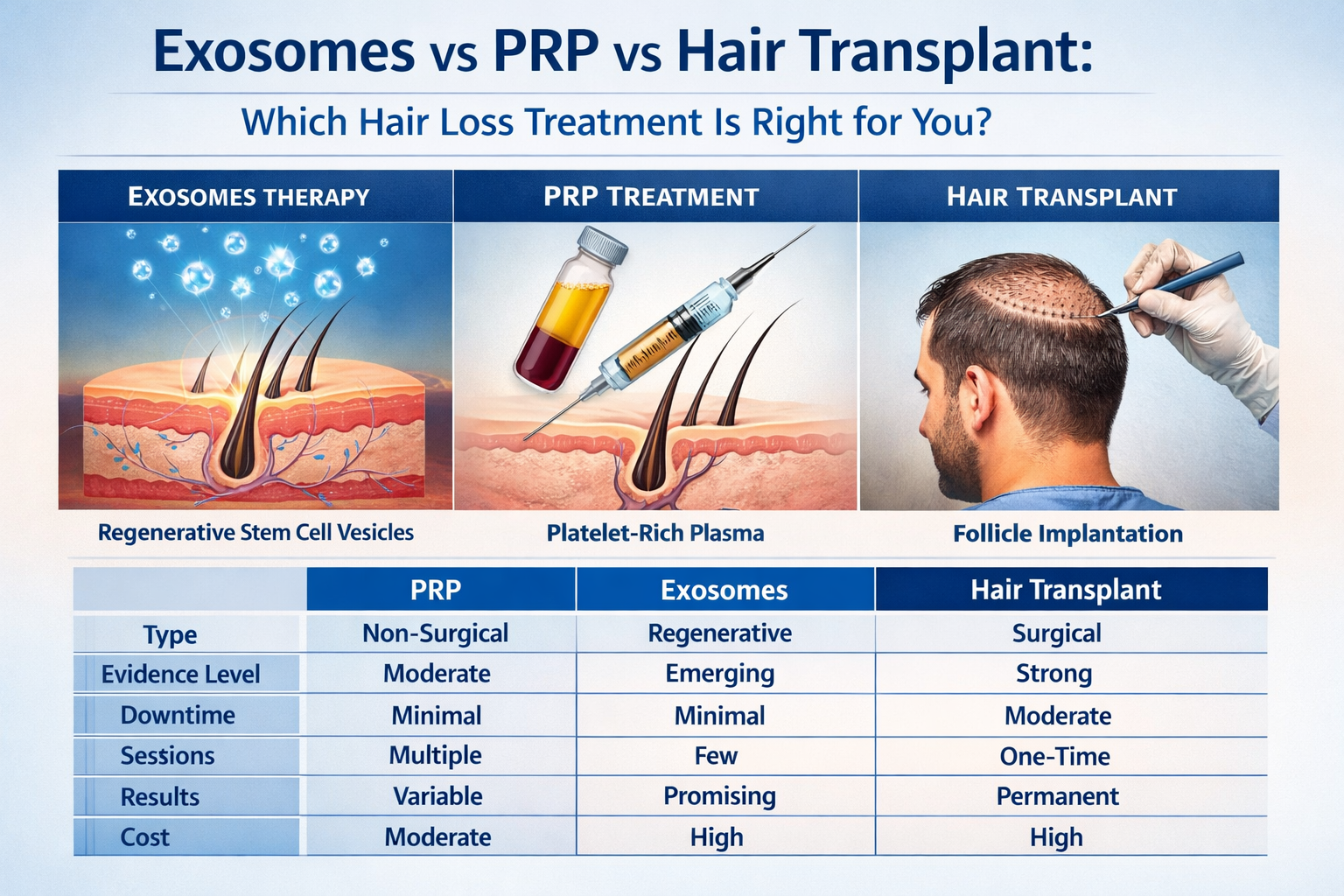
Comparison Table: PRP vs. Exosomes vs. Hair Transplant
To help you decide, here is a quick breakdown of how these treatments compare:
| Feature | PRP | Exosomes | Hair Transplant |
|---|---|---|---|
| Type | Non-surgical | Advanced regenerative | Surgical |
| Evidence Level | Moderate | Emerging | Strong |
| Downtime | Minimal | Minimal | Moderate |
| Sessions | Multiple | Few | One-time |
| Results | Variable | Promising | Permanent |
| Cost | Moderate | High | High |
Indications: What to Choose and When?
Choose PRP when:
- You are in the early stages of hair thinning (Grade I–III).
- You prefer a natural, low-risk option using your own biology.
- You need a maintenance therapy to keep existing hair healthy.
Choose Exosomes when:
- You have tried PRP but did not see the desired results.
- You have moderate hair loss and need a stronger regenerative boost.
- You are looking for the latest "next-gen" biotechnology.
Choose a Hair Transplant when:
- You have advanced baldness (Grade IV–VII).
- You have areas where follicles are completely lost and skin is smooth.
- You want a permanent solution to restore density in specific areas.
The Power of the Combination Approach
Modern hair restoration often uses a "best of both worlds" strategy. Many surgeons now recommend using PRP or Exosomes immediately after a hair transplant. These regenerative therapies can improve graft survival, speed up healing, and stimulate the surrounding non-transplanted hair. Combining surgery with regenerative medicine is often the most effective way to achieve a full, natural look.
Limitations and Reality Check
It is important to have realistic expectations:
- PRP: Results can vary significantly based on the patient’s own health and blood quality.
- Exosomes: While exciting, the industry still lacks universal standardization, and long-term evidence is still being gathered.
- Transplant: Success depends heavily on the surgeon's expertise and the amount of healthy donor hair available.
The Future of Hair Restoration
The field is moving toward personalized medicine. In the future, we expect to see more cell-free regenerative treatments like exosomes, AI-based follicle analysis to predict hair loss patterns, and highly customized protocols that combine medications with advanced therapies.
Frequently Asked Questions (FAQs)
Is PRP better than exosomes?
Exosomes are generally considered more potent because they contain a higher concentration of signaling molecules than PRP. However, PRP is autologous (from your own body), which some patients prefer.
Are exosomes safe?
Yes, when sourced from reputable labs and administered by professionals, exosomes are considered safe and have a low risk of adverse reactions because they are cell-free.
Can I avoid a transplant with PRP?
If caught early, PRP can significantly delay the need for a transplant by strengthening thinning hair. However, it cannot regrow hair in areas that are completely bald.
How long do results last?
PRP and Exosomes usually require maintenance sessions every 6 to 12 months. Hair transplant results are permanent.
Does the procedure hurt?
PRP and Exosomes involve small injections and cause minimal discomfort. Hair transplants are performed under local anesthesia, so you won't feel pain during the surgery.
Conclusion
There is no "one-size-fits-all" answer to hair loss. Your decision should be based on your age, the grade of your baldness, and your personal expectations. Whether you choose the regenerative power of exosomes, the proven track record of PRP, or the permanent results of a transplant, the first step is a professional evaluation.
Consult a qualified plastic surgeon for personalized advice to determine which path is right for your hair restoration journey.
Anant Aesthetic Clinic, Adampur