

Introduction
Traumatic brachial plexus injuries (BPI) represent some of the most complex challenges in reconstructive surgery. These injuries, often resulting from high-energy trauma, lead to profound functional deficits, including loss of motor control, sensory impairment, and chronic pain. While surgical interventions such as nerve grafting and nerve transfers are essential to restore continuity, surgery alone is rarely sufficient to achieve optimal functional recovery. Postoperative rehabilitation is the critical bridge between surgical success and the restoration of meaningful daily function.
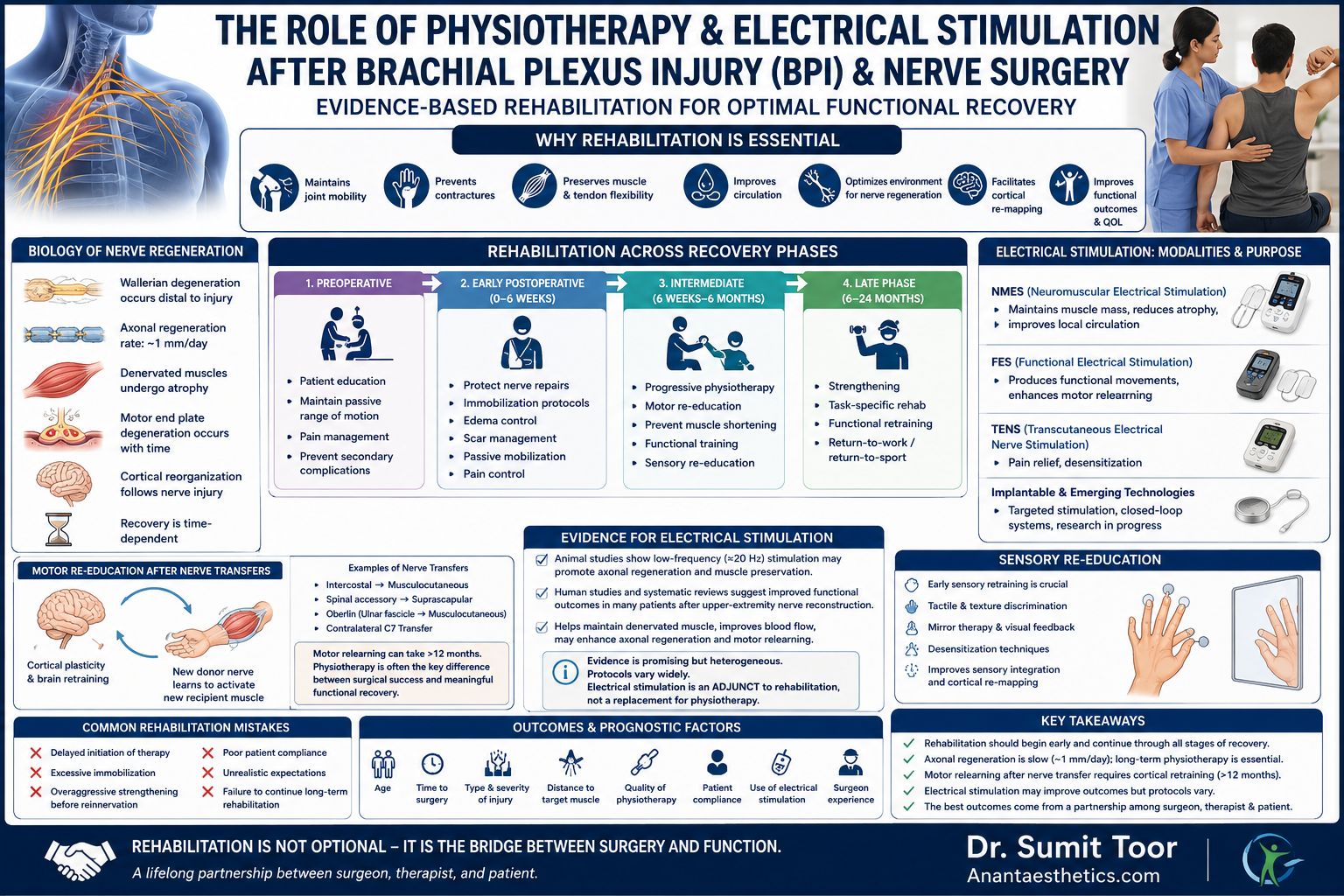
The Biology of Nerve Regeneration
The biology of nerve regeneration is a slow, time-dependent process. Following injury, Wallerian degeneration occurs, where the distal segment of the nerve fiber disintegrates. Axonal regeneration proceeds at a rate of approximately 1 mm per day. During this period, muscles undergo denervation atrophy, and motor end plates may degenerate if reinnervation is not achieved in a timely manner. Furthermore, the brain undergoes cortical reorganization, necessitating active retraining to ensure the central nervous system can effectively utilize the newly restored pathways.
The Essential Role of Physiotherapy
Physiotherapy is not merely an adjunct; it is a fundamental component of the recovery process. It serves to maintain joint mobility, prevent debilitating contractures, preserve muscle and tendon flexibility, and minimize stiffness. By improving local circulation and reducing edema, physiotherapy creates an optimal biological environment for regenerating axons to reach their target muscles.
- Rehabilitation must begin early and continue systematically through all stages of recovery.
- Axonal regeneration occurs slowly (~1 mm/day), making long-term, dedicated physiotherapy essential.
- Rehabilitation after nerve transfer surgery requires intensive motor relearning and cortical retraining, often extending beyond 12 months.
Connect & Locate Our Clinic
To discuss your specific recovery plan, please reach out to our team directly through any of our channels:
Rehabilitation Across Recovery Phases
Recovery from a brachial plexus injury is a marathon, not a sprint. A structured, phase-based rehabilitation protocol ensures that therapeutic interventions align perfectly with the biological stages of nerve healing.
Focuses on patient education, maintaining passive range of motion, and managing pain to prevent secondary complications before surgery.
Prioritizes protection of delicate nerve repairs, edema control, and gentle passive mobilization to prevent joint stiffness.
Introduces progressive motor re-education and sensory retraining to prevent muscle shortening as axons begin to regenerate.
Shifts toward intensive strengthening, task-specific functional training, and comprehensive return-to-work protocols.
Motor and Sensory Re-Education
Nerve transfer surgery, such as the Oberlin transfer or intercostal-to-musculocutaneous transfer, relies heavily on cortical plasticity. Patients must learn to 're-map' their brain to trigger new muscles using donor nerves. Sensory re-education, including texture discrimination and mirror therapy, is equally vital to help the brain interpret new sensory inputs correctly.
Electrical Stimulation: Evidence and Application
Neuromuscular Electrical Stimulation (NMES) and Functional Electrical Stimulation (FES) are powerful tools in the rehabilitation toolkit. Evidence suggests that low-frequency stimulation (approximately 20 Hz) can promote axonal regeneration and reduce muscle atrophy.
What the Science Says
While these technologies are not a replacement for active physiotherapy, they serve as a valuable adjunct to enhance motor relearning and maintain muscle health during the long wait for reinnervation. Systematic reviews suggest better functional outcomes in many patients receiving electrical stimulation after upper-extremity nerve reconstruction, although optimal treatment parameters remain heterogeneous and require expert customization.
Common Mistakes and Prognostic Factors
Recovery is often hindered by delayed therapy, overaggressive strengthening before reinnervation, or poor patient compliance. Success is highly dependent on factors such as the patient's age, the time elapsed since injury, and the quality of the multidisciplinary rehabilitation program.
- Delayed Initiation: Waiting too long to start therapy can lead to irreversible joint stiffness and muscle atrophy.
- Premature Strengthening: Attempting heavy resistance training before the nerve has fully reinnervated the muscle can cause damage.
- Inconsistent Compliance: Nerve recovery requires daily, long-term commitment to prescribed exercises.
About Anant Aesthetic Clinic
Anant Aesthetic Clinic, located in Adampur, is led by the highly esteemed Dr. Sumit Toor and Dr. Pratibha Toor. The clinic is dedicated to providing expert care in reconstructive and aesthetic procedures, emphasizing a patient-centered approach to recovery and long-term functional health. By combining advanced surgical techniques with evidence-based rehabilitation protocols, the clinic ensures that patients recovering from complex nerve injuries receive the comprehensive care necessary to reclaim their quality of life.