

Abstract
The integration of Artificial Intelligence (AI) into aesthetic plastic surgery has transitioned from experimental novelty to clinical necessity. AI-based facial simulation tools, such as GreatLooks.ai, offer unprecedented capabilities in visualizing potential post-operative outcomes, thereby enhancing patient education and alignment of expectations. However, this technological leap introduces complex medico-legal challenges. This article examines the legal ramifications of AI simulations, focusing on the risks of misrepresentation, the evolution of informed consent, and the specific regulatory landscape in India. By analyzing the intersection of surgical autonomy, algorithmic bias, and consumer protection laws, we provide a framework for practitioners to mitigate liability while leveraging AI to improve patient satisfaction and practice growth.
Introduction
The field of aesthetic surgery has always been at the forefront of technological adoption. From the early days of manual 2D photo-morphing to the sophisticated 3D imaging systems of the last decade, the goal has remained constant: to bridge the communication gap between the surgeon’s technical plan and the patient’s aesthetic desires. The rise of Generative AI and machine learning has birthed a new generation of simulation tools that are faster, more accessible, and remarkably realistic.
Tools like GreatLooks.ai utilize deep learning algorithms to process patient photographs and generate high-fidelity simulations of procedures such as rhinoplasty, blepharoplasty, and facial contouring. While these tools are powerful assets for consultation, they operate in a legal gray area. As simulations become indistinguishable from reality, the risk of a patient perceiving a simulation as a "guaranteed result" increases, necessitating a rigorous re-evaluation of our medico-legal protocols.
Clinical Utility of AI Simulation Tools
The primary clinical value of AI simulation lies in expectation management. Aesthetic surgery is unique because the "success" of a procedure is often subjective, defined by patient satisfaction rather than the mere absence of pathology. AI tools allow surgeons to translate abstract surgical goals into a visual language that patients can understand.
- Patient Education: Simulations help patients understand the limitations of their anatomy. For instance, showing how a specific nasal tip projection might look on their unique facial structure can ground their expectations in reality.
- Expectation Alignment: By visualizing the "middle ground" between a patient’s wish list and the surgeon’s technical capability, AI reduces the likelihood of post-operative dissatisfaction.
- Practice Growth: From a marketing perspective, these tools increase conversion rates. Patients are more likely to proceed with a procedure when they feel a sense of certainty and partnership in the planning process.
Medico-Legal Risks
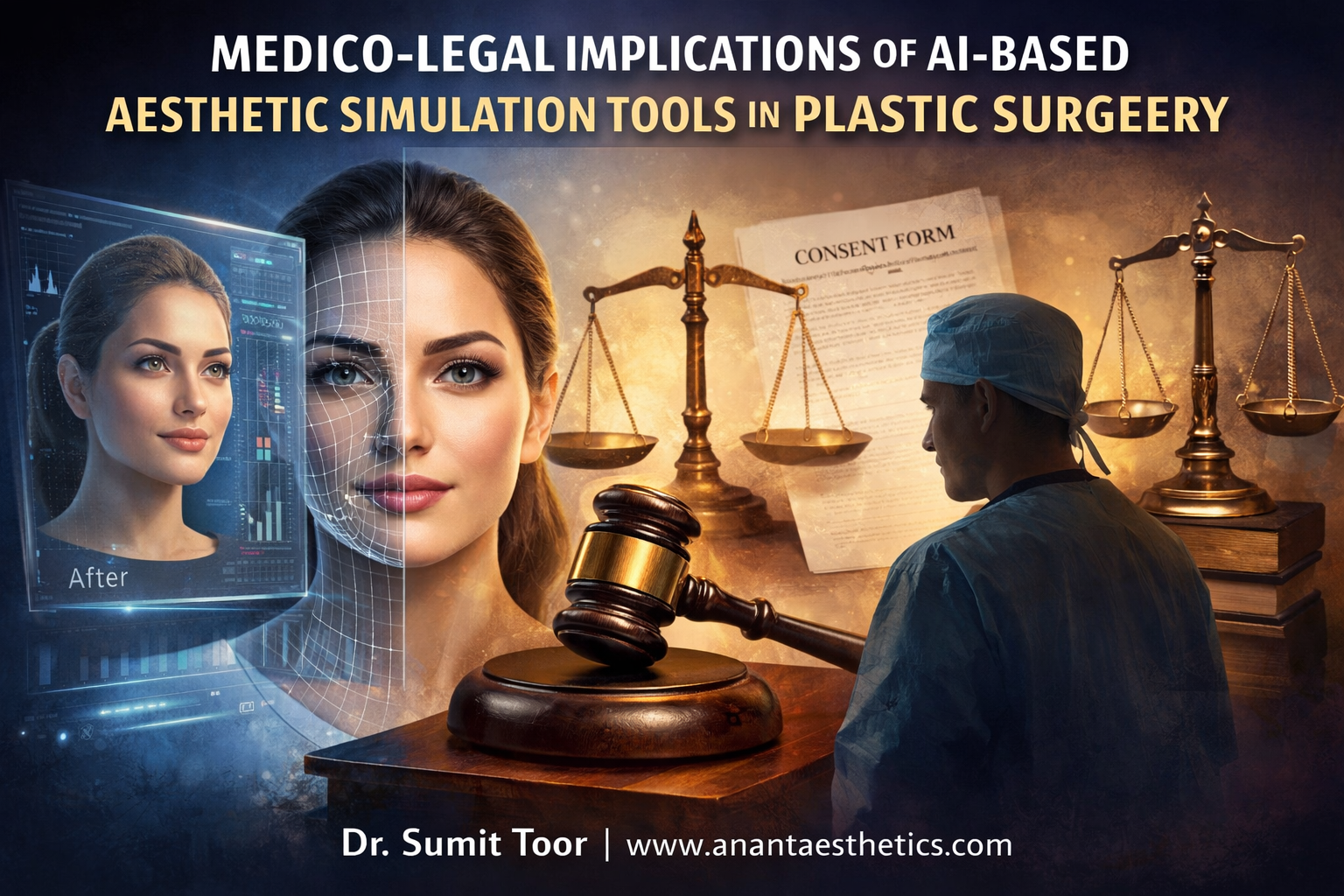
Despite their benefits, AI simulations carry significant legal weight. The most prominent risk is the misrepresentation of outcomes. In many jurisdictions, a visual simulation can be interpreted as a "warranty of result" or a "contractual promise." If the final surgical outcome deviates significantly from the AI-generated image, the practitioner may face claims of breach of contract or professional negligence.
Furthermore, the hyper-realism of modern AI can foster unrealistic expectations. Unlike traditional morphing, which often looked "edited," AI simulations can look so natural that patients may fail to account for the biological variables of healing, scarring, and tissue response. Liability in cases of dissatisfaction often hinges on whether the surgeon adequately communicated that the simulation was merely an illustrative tool, not a definitive map of the future.
Data Privacy and Consent: AI tools often require uploading patient data to the cloud. This raises concerns regarding data sovereignty and compliance with privacy laws like the GDPR or India’s DPDP Act. Practitioners must ensure that the AI vendors they use maintain high standards of data encryption and that patients are aware of how their images are being processed.
Informed Consent in the AI Era
The traditional informed consent process must evolve to include the nuances of AI. It is no longer sufficient to discuss risks like infection or hematoma; we must now discuss the limitations of the simulation itself. Should AI-generated images be part of the formal consent document? The consensus among medico-legal experts is shifting toward "yes," provided they are accompanied by robust disclaimers.
Documentation strategies should include saving the simulated images alongside the pre-operative photos in the patient’s Electronic Medical Record (EMR). This creates a clear trail of what was discussed and what the patient agreed to. Surgeons must explicitly state that the simulation does not account for individual healing patterns or unforeseen surgical complexities.
connect with the doctor follow us on Instagram locate us on the button
Ethical Considerations
Ethical practice in the age of AI requires an understanding of algorithmic bias. Many AI models are trained on specific datasets that may not represent the full spectrum of human diversity. If an AI tool consistently suggests "Eurocentric" features to a patient of a different ethnic background, it may inadvertently pressure the patient toward an aesthetic that does not respect their heritage.
There is also the risk of over-promising. An AI might generate a result that is surgically impossible or structurally unsound. The surgeon must maintain autonomy and have the courage to override the AI’s suggestion if it conflicts with clinical reality. The AI should assist the surgeon, not dictate the surgery.
Indian Medico-Legal Perspective
In India, the legal landscape for medical practitioners is governed largely by the Consumer Protection Act (CPA), 2019, and the guidelines set by the National Medical Commission (NMC). Under the CPA, medical services are considered "services," and any perceived failure to meet the promised outcome can be litigated as a "deficiency in service."
Indian courts have traditionally followed the Bolam Test and the Montgomery principle, emphasizing that a doctor is not negligent if they act in accordance with a responsible body of medical opinion and provide adequate disclosure of risks. However, the use of AI simulations adds a layer of complexity. If a surgeon uses an AI tool that is not "validated" or "approved" by regulatory bodies, they may be held to a higher standard of liability if things go wrong. Furthermore, the Digital Personal Data Protection (DPDP) Act, 2023, mandates strict consent for processing personal biometric data, which includes facial photographs used in AI simulations.
Risk Mitigation Strategies for Practitioners
To protect themselves and their patients, practitioners should adopt a standardized protocol for AI use:
- Standard Disclaimers: Every simulated image should have a watermark or a clear caption stating its illustrative nature.
- Documentation: Record the consultation where the simulation was shown, noting the patient’s verbal understanding that the image is a goal, not a guarantee.
- Counseling: Use the simulation to highlight what cannot be achieved as much as what can.
Sample Disclaimer Text:
"This AI-generated simulation is for educational and illustrative purposes only. It represents a mathematical estimation of potential surgical outcomes based on current technology. It does not constitute a warranty, guarantee, or promise of the final result. Actual surgical outcomes are subject to individual biological variations, healing processes, and surgical limitations. By proceeding, the patient acknowledges that the final result will differ from this simulation."
Future Directions
The future will likely see the integration of AI simulation tools directly into EMR and digital consent platforms. We can expect stricter regulation of AI as a "Medical Device" (SaMD - Software as a Medical Device). As these tools become more sophisticated, incorporating 4D simulations (showing aging or movement), the legal frameworks will need to be even more robust to protect both the patient’s rights and the surgeon’s professional integrity.
Conclusion
AI-based aesthetic simulation tools are transformative, offering a powerful bridge between surgical vision and patient expectation. However, they are not without peril. By treating these tools as aids to communication rather than definitive outcomes, and by grounding their use in rigorous informed consent and ethical practice, plastic surgeons can harness the power of AI while minimizing medico-legal exposure. In the evolving landscape of Indian law, staying informed and maintaining transparent patient communication remains the best defense against litigation.
Anant Aesthetic Clinic, Adampur